
When “Holding It Together” All Day Comes Crashing Down
Have you ever noticed that your child comes home from school or daycare tearful, irritable, withdrawn, or explosive, despite reports that they were “fine” all day?
For many families, afternoons and evenings can feel like the hardest part of the day. This can be confusing, exhausting, and emotionally heavy for parents and caregivers who are doing their very best.
🎥 Watch: After School Meltdowns | Communication Strategies from a Waterloo Speech-Language Pathologist
Understanding Restraint Collapse (Through a Communication Lens)
What many families are observing is often recognized as restraint collapse.
Throughout the day, children work incredibly hard to meet expectations in environments that are often:
- loud and busy
- socially demanding
- language-heavy
- sensory-rich
They may be:
- following rules
- listening and responding to adults
- navigating peer interactions
- managing transitions
- processing large amounts of spoken language
For some children, especially neurodivergent children, this sustained effort requires significant cognitive, emotional, and communication energy.
When children finally arrive home, a place where they feel safest, their nervous system no longer has to “hold it together.” The result can look like a meltdown, but it’s not misbehaviour or manipulation—it’s a release.
Importantly, restraint collapse is not a sign you’ve done something wrong. It’s often a sign of your child’s trust in you and the safety of your home—essentially, your child feels safest with you at home.
“They’re Having a Hard Time, Not Giving You a Hard Time”
This simple reframe can be incredibly grounding for caregivers.
When a child is overwhelmed, their brain may be in a state of emotional and cognitive overload. During these moments:
- language processing is harder
- expressive language may temporarily decrease
- problem-solving is limited
- reasoning and long explanations are difficult to process and comprehend.
From a speech-language pathology perspective, this means communication expectations need to shift.
Why Communication Can Feel Harder After School
After a long day, many children experience:
- reduced tolerance for questions
- difficulty finding words
- increased reliance on gestures, behaviour, or silence
- frustration when language doesn’t come easily
This isn’t regression—it’s fatigue. Communication is a brain-based skill, and like any skill, it’s affected by stress, fatigue, hunger, and sensory load.
Supporting Communication During After School Meltdowns
Rather than focusing on “fixing” the meltdown, communication support works best when it focuses on reducing load and increasing safety.
1. Connection Comes First
Before asking questions or giving directions, focus on connection:
- a warm greeting
- sitting nearby
- offering closeness if welcomed
Some children need quiet space. Others need physical or emotional proximity. There is no one “right” response—what matters is meeting your child where they are and following their lead.
Examples of Following Their Lead:
- If they turn their body away or hide their face: Give them space by backing up slightly or focusing on a quiet task nearby (e.g., preparing dinner). This signals you are present but not demanding interaction.
- If they are melting into you or leaning heavily: Offer a firm loving hug (if welcomed) or simply sit quietly next to them without talking. This provides the physical presence and comfort they may be seeking.
- If they are pacing or restless: Offer an activity that involves movement, like playing catch, swinging, or going for a short walk, rather than forcing them to sit down.
2. Reduce Language Demands
When children are overwhelmed, less language is better:
- short phrases
- calm tone
- predictable wording
Examples:
- “You’re home now.”
- “First snack, then play.”
- “We can rest.”
This helps reduce cognitive load and supports comprehension.
3. Use Visual and Predictable Supports
Visuals, routines, and first/then language can be especially helpful after school:
- visual schedules
- pictures or gestures
- consistent routines
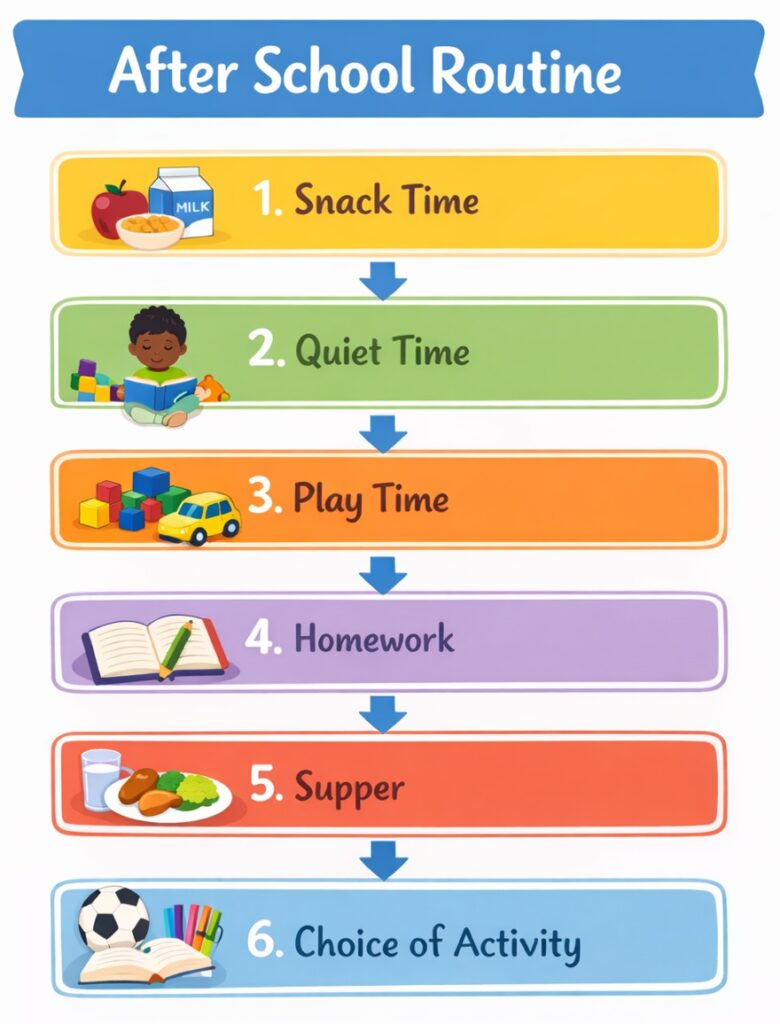
These supports allow children to understand expectations without needing to process a lot of spoken language.
4. Narrate with Empathy, Not Pressure
Instead of directing behaviour, try narrating what you notice:
- “That was a long day.”
- “Your body looks tired.”
- “I’m here with you.”
This models emotional language without requiring a response and gives children words they may use later when they’re ready.
5. Protect Time for Decompression
Many children need time to reset before engaging in conversation, homework, or activities. This might include:
- movement (e.g., jumping on a trampoline, swinging, or climbing stairs)
- quiet, focused creation (e.g., drawing, colouring, painting, or building with LEGO/blocks)
- low-demand play (e.g., putting a puzzle together, Rubik’s Cube, playing with preferred toys)
- sensory input (e.g., chewing gum/snacks, fidget toys, or playing with sand, playdough or water)
Decompression is not avoidance—it’s preparation.
Neurodiversity-Affirming Reframe 🧡
From a neurodiversity-affirming perspective, after-school meltdowns are communication.
They tell us:
- the day required a lot energy
- the child used tremendous effort
- the environment may have been demanding
Our initial role during the overwhelm is not to teach children to suppress their feelings, but to first focus on safety and regulation so the child is able to learn alternative positive ways of expressing themselves. Our role is to:
- reduce unnecessary pressure and environmental demands
- adapt communication expectations
- support regulation and connection
- gently guide and teach new skills (like requesting space or identifying triggers) when the child is regulated.
Research and lived experience show that children learn and communicate best when they feel safe, understood, and accepted. This foundation of safety and acceptance is what allows us to later teach supportive strategies and maintain loving boundaries.
When to Seek Additional Support
If after-school overwhelm is:
- persistent and intense
- affecting family well-being
- consistently interfering with your child’s ability to communicate or participate
A speech-language pathologist can help explore:
- communication load
- language processing demands
- self-advocacy skills
- supportive strategies tailored to your child
Support doesn’t mean something is “wrong.” It means you’re listening.
📍 Private Pediatric Speech Therapy in Waterloo, Ontario
At Communicating Together Therapy & Wellness Associates, we provide neurodiversity-affirming, child-centred speech-language support for children and teens. We focus on communication that works for your child—not forcing them to fit a mold.
👉 Visit communicatingtogether.ca to learn more or reach out to connect.
📚 Looking for More? Explore Our Resources and Family-Friendly Strategies
You may also find these helpful:
- Is This Just a Phase? When to Seek Speech-Language Support
- Hidden Communication Challenges in Kids: Pause Before You Judge
- What is Neurodiversity-Affirming Speech Therapy? | Speech Therapist Explains
- Read more on our blog
📱 Follow Us on Social Media
Follow along on social media for inclusive tips, encouragement, and resources (links at the bottom of every page on our website).
📝 A Note to Parents and Caregivers
If afternoons feel hard, please know—you are not failing.
Your child’s big feelings are not a reflection of poor parenting. They are often a reflection of how much effort your child puts into navigating their world. Communication grows through connection, patience, and compassion—for your child and for yourself.
⚠️ Disclaimer
This blog is for general informational purposes only and does not replace individualized assessment or therapy. Please consult a doctor, psychologist, or licensed speech-language pathologist for guidance specific to your child.
👋 Take care,
Rhonda MacKinnon, M.Sc., S-LP(C), Reg. CASLPO – Speech-Language Pathologist